
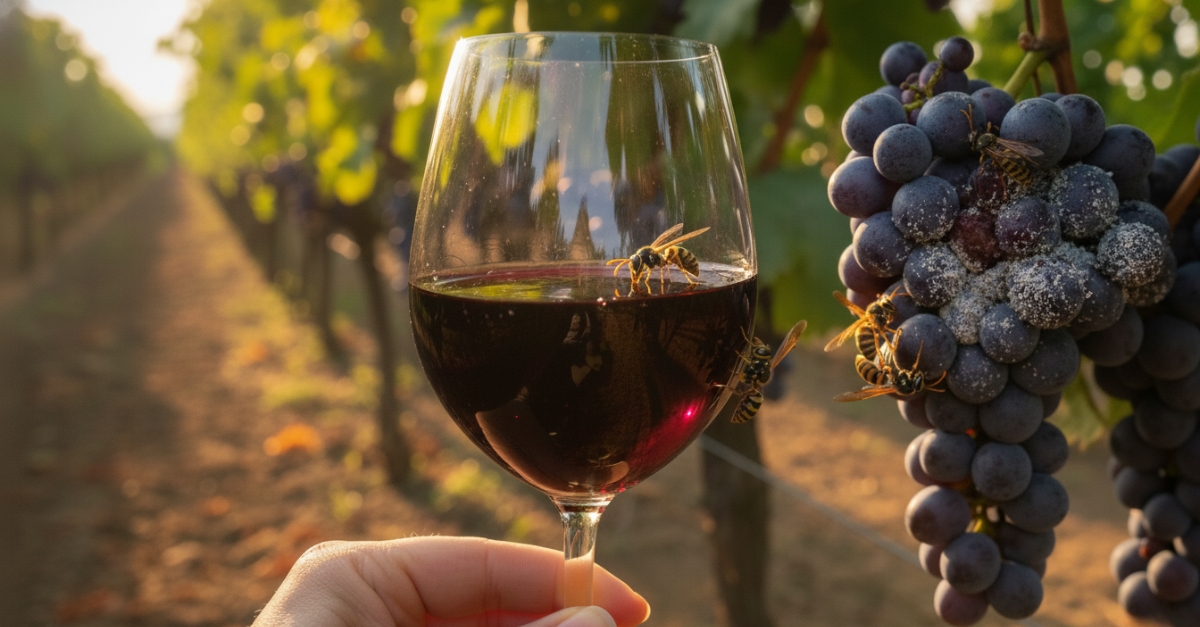
Did you know that some studies suggest wasps can improve the quality of wine produced in vineyards where they are present? This surprising relationship between insects and winemaking has attracted the attention of researchers. But what exactly explains this particular symbiosis?
Why Can Wasps Improve Wine?
According to the study “The social wasps as a reservoir of non-Saccharomyces yeasts for bio-protection strategies in winemaking”, conducted by a group of Italian researchers and published in the journal Applied Microbiology and Biotechnology, vineyards where wasps are present may produce higher-quality wines.
The reason lies in the biological role these insects play. Wasps act as essential biological agents by transporting and preserving the yeast Saccharomyces cerevisiae in their digestive tract during the winter. When they feed on grapes in the summer, they transfer this key fermentation yeast to the fruit. This process contributes unique aromatic nuances and enhances the overall complexity of the wine.
The research demonstrated this relationship by studying the role of social wasps from the genera Polistes and Vespula as reservoirs and vectors of yeasts in vineyards located in Tuscany.
Why Is the Relationship Between Wasps and Wine Studied?
The study, carried out by Damiano Barbato, Simona Guerrini, Viola Galli, Eleonora Mari, Marzia Cristiana Rosi, and Lisa Granchi, focused on vineyards located in the controlled designation of origin areas (DOCG) of Chianti Classico, Brunello di Montalcino, and Vino Nobile di Montepulciano.
Its objective was to analyze the yeast species associated with local wasps and isolate strains with potential use as bioprotection agents in winemaking.
Researchers aimed to demonstrate that certain yeast strains present on grapes matched those found in the intestines of wasps captured in the same vineyards. This discovery provides strong evidence that these insects directly influence the uniqueness and quality of wines produced in the region.
How Do Wasps Act in Vineyards?
Wasps function both as a natural reservoir and as a vector that helps preserve and disperse non-Saccharomyces yeasts throughout vineyards.
They also play a key role in discovering new native yeast strains that can be used in winemaking, especially those capable of enhancing aroma and controlling undesirable microorganisms that appear in vineyards.
All of this can be achieved without relying on chemical additives. In fact, one of the most important conclusions of the study is that these benefits come from using local resources naturally present in vineyard ecosystems.
What Are the Keys to the Relationship Between Wasps and Wine?
According to the research published last November, several key factors explain the connection between wasps and wine:
- Yeast transfer in vineyards
Wasps are essential for transporting and spreading yeasts. They carry these microorganisms in their digestive system during winter and deposit them on grapes when feeding, initiating a more natural fermentation process. - Unique aromatic complexity
The “non-conventional” yeasts transported by wasps contribute distinctive aromatic nuances and improve the final taste of wine, increasing its complexity. - Support for sustainable viticulture
The presence of wasps is often linked to a balanced ecosystem, which is crucial for the development of organic and regenerative viticulture. - Natural pest control
By interacting with the vineyard ecosystem, wasps help control pests, reducing the need for chemical treatments in crops.
WINERYON and Wasps
At WINERYON, we welcome the growing number of studies highlighting the importance of sustainable practices in vineyard management and winemaking. For years, we have been working with this philosophy in mind.
For this reason, we celebrate findings that show how wasps help ensure the presence of the best natural yeasts on grapes, resulting in wines with greater organoleptic richness.
Research like this motivates us to continue supporting high-quality wines produced in a natural and sustainable way, just like our DEMUERTE collection.
